
The next AI bottleneck: Networking
Faster connections, uneven rewards
- Larger AI systems need faster connections, making physical networking an increasingly important part of infrastructure spending.
- Within these networks, fiber optics and copper wires carry data between racks and across data centers.
- New capacity and new ways to connect AI systems could reshape margins, even as demand continues to grow.
Why AI needs faster connections
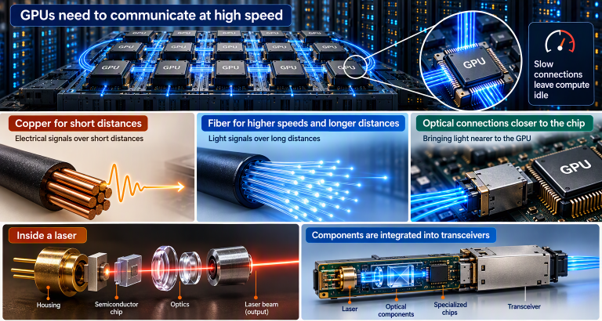
The performance of an AI system depends on how quickly its chips can communicate. Thousands of GPUs often work together on the same task and continuously exchange large amounts of data, so any delay in the network can leave valuable computing capacity idle.
Copper vs fiber? Copper remains an efficient and relatively inexpensive solution to transmit data over short distances, as it carries electrical signals directly. As data speeds increase and distances grow, however, optical fiber becomes more effective than copper because it transmits information as light. Fiber already connects equipment across data centers, and manufacturers are now working to bring optical connections closer to the chips.
Energy consumption is the other part of the equation. Moving data requires electricity, and the amount needed rises as AI systems become larger. More efficient networks reduce the energy spent on communication, leaving a greater share of the data center’s power available for the core task: computing.
Let’s now look at how optical connections are made and how they can be brought closer to the chip.
As data speeds increase and distances grow, optical connectivity becomes essential.
Kurt Ruts, CFA - Buy-side equity analyst at KBC Securities.
Growing demand does not guarantee stronger profits
Optical connections combine several components:
- Lasers, which produce light;
- Optical components, which use that light to send and receive data and
- Specialized chips that help keep the signal clear.
These parts are often combined into modules called transceivers, which connect equipment to optical fiber.
We believe that laser is the part of the value chain where most of the value will be captured. That is because laser manufacturing requires specialist materials, precise production processes and yields high enough to make each batch profitable. Customers also need to test and approve the products before using them. Adding capacity therefore takes time, which can help manufacturers defend prices and margins when supply falls short of demand.
In contrast, competition is tougher further downstream. Transceiver suppliers face pricing pressure because customers can choose from several manufacturers globally. Likewise, equipment makers depend on investment in factories, leaving revenues exposed to the timing of expansion projects.
How a new technology changes the market
AI requires faster connections capable of moving more data while using less energy. New optical architectures are changing the mix of components used in AI infrastructure, creating opportunities for some suppliers while gradually eroding demand for older products.
The scale of this shift will depend on the pace of customer adoption and suppliers’ ability to adjust their products and production. Expanding capacity requires time and investment, while adding too much too quickly can intensify competition and put pressure on prices.
Conclusion
Growth across optical networking could therefore be significant, but lasting profits will depend on keeping pace with technological change, managing capacity and controlling costs. Share prices may already reflect part of this potential. Therefore, we focus on which suppliers can defend pricing during a capacity buildout phase, favoring companies that sit in the part of the value chain that captures most value, like lasers and optical chips.
DISCLAIMER
This publication is a marketing communication within the meaning of MiFID II. It is a publication of KBC Securities NV (KBCS) and is distributed by KBC Securities NV (KBCS). It has not been prepared in accordance with legal requirements designed to promote the independence of investment research. The authors of this publication may hold financial instruments in this company and are bound by certain pre-publication dealing restrictions. More information on this can be found at the webpage mentioned below. The recommendations in this publication were formulated by the author based on general publicly available information and reports available on the websites of the company, Bloomberg and Eikon Refinitiv that are integrated in a financial model. The authors follow a methodology that aims to achieve objectivity, impartiality, data and source quality, in order to deliver analyses that reflect the unbiased opinions of the authors. More information on the methodology is available on the webpage mentioned below. The recommendations in this publication may differ from recommendations of other KBC Group entities (such as KBC Asset Management NV) because of differences in methodologies and because the overall valuation of a financial instrument depends on the perspective, e.g. the balance within a portfolio, the net asset value of a specific financial instrument or the time horizon. KBC Asset Management NV acts on the basis of its own strategy in the interests of the funds under its management, independently of the buy-side insights published by KBC Securities NV. There is no direct link between the remuneration of the authors of this publication and transactions which may arise from this publication; rather, that remuneration depends on the total overall annual activity of KBC Securities NV. This publication does not constitute investment advice and does not take into account the individual circumstances and objectives of the investor. Investing involves risks, including the risk of loss of the entire invested capital when investing in shares. Inexperienced investors should seek independent financial advice before making any investment decision. None of KBC Securities NV or the authors of this publication, accepts any liability (whether in law, contract or tort) against any (direct or indirect) recipient of this publication for any direct or indirect losses that recipient suffers or may suffer because of an action that recipient has taken or not taken (or has advised or recommended someone else to take) based on the content of this publication (including any projections, analyses, assumptions or opinions therein). KBC Securities NV has no legal obligation to update the recommendations or other content contained herein. KBC Securities NV has no schedule for issuing buy-side insights and they are issued whenever its financial analysts consider it relevant. Any opinions expressed in this publication reflect the views at the time the document was compiled and may be changed without prior notice. Due to lack of space, a number of essential elements pertaining to this investment recommendation (including the rules on conflicts of interests) have not been included in this document. To consult them, please go to this webpage on the website of KBC Securities NV: www.kbcsecurities.com/en/legal-information/investment-recommendations.html and click on ‘buy-side insights’. The competent regulator in respect of this publication is the Belgian Financial Services and Markets Authority (FSMA) (www.fsma.be)
Why commodity prices reach earnings with a delay
Beyond food: hydropower, mining and transport
El Niño’s impacts extend beyond soft commodities, with notable examples being electricity generation, mining, and transport.
Hydropower-dependent regions are particularly sensitive because lower reservoir levels reduce cheap generation and may force corporates to purchase more expensive replacement power. This matters especially for smelters, which need a continuous, large-scale power supply. As some of China’s smelting capacity has moved to hydro-rich regions, its exposure to drought has increased.
Copper presents a more mixed picture. Heavy rainfall and flooding can disrupt mining operations in parts of Peru and northern Chile, reducing output and supporting prices. The impact on earnings, however, depends on each miner’s geographic exposure and the severity of the disruption.
Finally, transport links form another potential transmission channel, as low water levels can restrict vessel capacity through for instance the Panama Canal, similarly to what happened during summer 2026 to the Rhine river in Germany. Such constraints can raise freight costs and lengthen delivery times, although the financial impact depends on the duration of the disruption and the availability of alternative routes.